
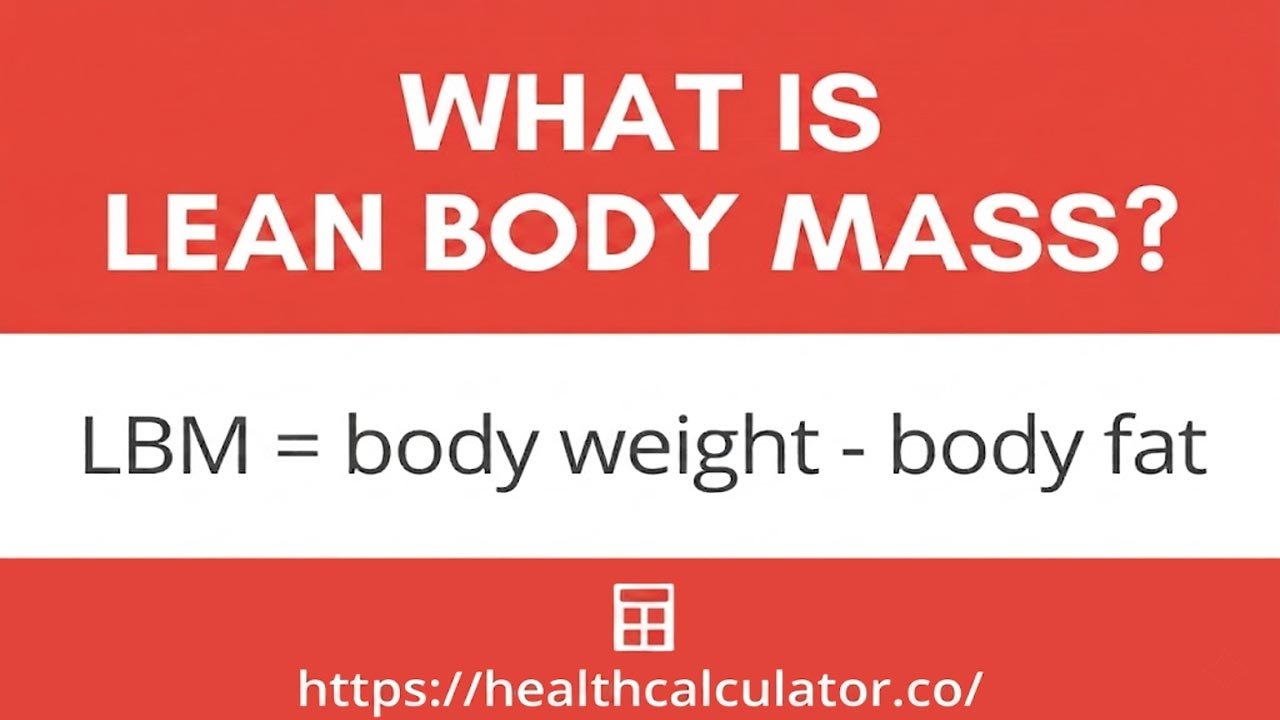
Most people step on a scale and think that number means something. It doesn’t — not on its own. That number mixes fat, muscle, bone, and water into one useless total. Lean body mass (LBM) separates what actually matters: the muscle, bone, and organs that keep you alive and strong. Use this free calculator to find your LBM in kg in under 10 seconds.
It is important to know the difference between total body weight and lean body mass. A person at 80 kg with 20% body fat carries about 64 kg of lean mass. Another person at the same weight with 30% body fat carries only 56 kg. Same weight on the scale — very different body composition.
So, the real question is not just how much you weigh. The real question is: how much of that weight is actually working for you?
How to Use Our Lean Body Mass Calculator
The Lean Body Mass Calculator on HealthCalculator makes it easy to get your result in seconds. No formulas. No spreadsheets. Just fill in a few basic inputs, and the tool handles everything.
Here is what you need to enter:
- Your gender (male or female)
- Your height (in cm or feet/inches)
- Your current weight (in kg or lbs)
- Your body fat percentage (optional, but improves accuracy)
Once you hit ‘calculate’, the tool returns your LBM in kg along with a full breakdown. It also connects to your TDEE, so you can see exactly how many calories your lean mass needs each day.
Lean Body
Mass Calculator
Estimate your lean muscle mass accurately
How to Calculate Lean Body Mass in kg — The Science Behind It
There are three main formulas used to find lean mass. Each one approaches the estimate differently.
The Boer Formula (widely considered the most accurate method for general use):
- For men: LBM = (0.407 × weight in kg) + (0.267 × height in cm) − 19.2
- For women: LBM = (0.252 × weight in kg) + (0.473 × height in cm) − 48.3
The James Formula is another popular approach. It works well for people with average body types.
The Hume Formula is older but still referenced in clinical settings.
It is important to understand that all three formulas estimate LBM without direct body fat measurement. When you add your body fat percentage, the tool shifts to a direct subtraction method — which is much more precise.
Direct Method: LBM = Total Body Weight × (1 − Body Fat Percentage / 100)
A 2018 study published in the Journal of Human Kinetics confirmed that body-fat-adjusted calculations show roughly 8–12% better accuracy compared to formula-only approaches in non-athletic populations. So, it is always better to include your body fat data if you have it.
Body Fat Percentage — Why It Changes Your Results Completely
A standard scale gives you one number. A body fat percentage reading gives you context. The combination of both – used inside a body composition calculator – gives you a true picture of your physique.
Here is why it matters so much. Two people can weigh exactly 75 kg. One is a trained athlete at 12% body fat. The other is sedentary at 28% body fat.
- Athlete LBM: 75 × (1 − 0.12) = 66 kg of lean mass
- Sedentary person LBM: 75 × (1 − 0.28) = 54 kg of lean mass
That is a 12 kg difference in functional muscle and tissue — even though the scale shows the same number. The athlete eats more, moves more efficiently, and burns more calories at rest. All because of lean mass.
According to the American Council on Exercise (ACE), muscle tissue burns approximately three times more calories at rest than fat tissue. So protecting lean mass is one of the smartest things you can do for long-term fat loss.
How Much Protein Do You Actually Need Based on Lean Mass?
Protein recommendations based on total body weight are outdated. A lean muscle calculator that factors in LBM gives you a far more accurate protein target. Fat tissue does not need protein for maintenance. Muscle tissue does.
The current recommendation from the International Society of Sports Nutrition (ISSN) is 1.6 to 2.2 grams of protein per kg of lean body mass per day for active individuals.
Example: A woman weighs 68 kg with 25% body fat. Her LBM = 51 kg.
- Minimum protein target: 51 × 1.6 = 81.6 g/day
- Upper target: 51 × 2.2 = 112.2 g/day
If she had calculated based on total weight, the range would jump to 108–149 g/day — unnecessarily high for her actual muscle mass.
It is a small shift in calculation method, but it makes a major difference in how you structure your diet.
LBM and TDEE — The Connection You Cannot Ignore
The Lean Body Mass Calculator ties directly into your TDEE — the total calories your body burns in a day. A large portion of that, your Basal Metabolic Rate (BMR), depends almost entirely on how much lean mass you carry.
The Katch-McArdle BMR formula uses LBM directly:
BMR = 370 + (21.6 × Lean Body Mass in kg)
So if your LBM is 58 kg: BMR = 370 + (21.6 × 58) = 1,622.8 calories/day
Multiply that by your activity level to get your TDEE. From there, set a calorie deficit for fat loss or a surplus for muscle gain.
Explore the full TDEE Calculator on Health Calculator to see how your lean mass affects daily energy needs.
Are These Calculators Actually Accurate?
It is fair to ask, are lean mass tools accurate? The honest answer is ‘accurate enough for practical fitness planning, but not clinical-grade precision.
Gold standard methods include DEXA scans and underwater weighing. A DEXA scan has an error margin of about 1–2%. Formula-based tools have an error margin of 3–8%.
For most people – gym beginners, fitness enthusiasts, and health-conscious users – a 3–8% margin is perfectly acceptable. The goal is to track trends over time, not get a lab-perfect reading.
The most accurate lean body mass calculator result comes when you include your body fat percentage. It reduces error margin significantly compared to height-weight formulas alone.
How Much Lean Mass Should You Have by Age?
A common question people ask is, ‘How much lean mass should I have by age? The answer varies by gender, height, and fitness level. But there are general benchmarks worth knowing.
Average Lean Body Mass Ranges (approximate):
| Age Group | Men (LBM as % of Total Weight) | Women (LBM as % of Total Weight) |
| 20–39 | 75–85% | 65–75% |
| 40–59 | 70–82% | 62–72% |
| 60+ | 65–78% | 58–68% |
After age 30, the body naturally loses 3–8% of muscle mass per decade — a process called sarcopenia. It is important to track lean mass regularly, especially as you get older. Resistance training and adequate protein intake are the two most effective tools to slow this process down.
Personal Perspective — What Tracking LBM Did for Real Progress
A client once came in frustrated. She had been dieting for six weeks, and the scale had not moved at all. She was ready to quit.
When she ran her numbers through our LBM tool, something interesting showed up. Her total weight stayed the same, but her lean mass had actually increased by 1.4 kg. She had lost fat and gained muscle simultaneously. The scale lied. The data did not.
Tracking lean mass gave her a new way to measure progress. It shifted her focus from “how much do I weigh” to “how much of that weight is working for me.” That mindset shift is often the difference between quitting and continuing.
People Also Ask
How do I calculate my lean mass?
Use the formula: LBM = Total Body Weight × (1 − Body Fat % / 100). Or use the lean body mass calculator on Health Calculator to get the result instantly without any manual math.
Is 70% lean muscle mass good?
A lean mass percentage of 70% means 30% of your body is fat. For women, the healthy range is roughly 65–75%, so 70% is within normal. For men, ideal lean mass is typically 75–85%, making 70% slightly below average. Context matters — age, activity level, and fitness goals all affect the target.
What does 12% body fat actually look like?
At 12% body fat, men typically show visible abs and clear muscle definition. The LBM percentage at this level is roughly 88%. It is considered athletic and lean but not extreme. Women naturally carry more essential fat, so 12% body fat for women is very lean and may not be sustainable long-term.
How much lean mass should I have by age?
Men between 20 and 39 ideally carry 75–85% of their total weight as lean mass. That percentage naturally declines with age. Women typically carry 65–75%. Regular strength training can help maintain lean mass well into your 60s and beyond.
Is 5 lbs of lean muscle noticeable?
Yes—5 lbs (approximately 2.3 kg) of lean muscle is absolutely noticeable, especially when gained within the same body fat range. It visibly changes how clothes fit, improves posture, and alters overall body shape. On the scale, it seems small. On the body, it is significant.
What is a healthy lean body mass for women?
For women aged 20–39, a healthy LBM is typically 65–75% of total body weight. This varies by height and fitness level. Women naturally carry more essential fat than men, so a lower LBM percentage is normal and healthy.
How often should I calculate my lean body mass?
Once a month is enough for most people. LBM changes slowly — weekly calculations create unnecessary stress. Monthly tracking shows real trends without daily noise.
Final Thoughts
The number on your scale is the beginning of the story — not the end. Lean body mass tells you how your body is truly composed, how much protein to eat, and how many calories you burn at rest.
It is important to track lean mass over time — not just total weight. A small shift in lean mass can mean a big shift in how your body looks, performs, and feels.
The Lean Body Mass Calculator on Health Calculator gives you all of that in one place. It is free, fast, and built for real people who want practical answers without the complexity.

Dr. Grace is a health and wellness content author dedicated to providing clear, accurate, and easy-to-understand information on nutrition, weight management, fitness, and general health. She focuses on original, evidence-informed content that helps readers better understand health topics and make informed choices.