

Let’s get one thing straight—that number flashing on your smartwatch after a workout? It’s probably wrong. Not a little wrong. Sometimes embarrassingly wrong. If you’ve ever wondered how many calories you actually burn in a day, the honest answer is it depends on a lot more than your step count.
This isn’t a post to scare you off fitness trackers. It’s a reality check—because understanding how calorie burn actually works will do more for your goals than chasing any number on a screen.
How Many Calories Do YOU Actually Burn Each Day?
Before we talk about exercise, let’s talk about what’s already happening in your body right now—just by existing.
Your Total Daily Energy Expenditure (TDEE) is made up of four parts:
- BMR (Basal Metabolic Rate): calories burned at complete rest (breathing, blood circulation, cell repair). This is 60–75% of most people’s daily burn.
- NEAT (Non-Exercise Activity Thermogenesis): fidgeting, walking to the kitchen, standing. Wildly underrated.
- TEF (Thermic Effect of Food): digesting food burns calories, too. Protein costs the most to digest.
- EAT (Exercise Activity Thermogenesis): your actual workouts. Smaller slice than most people think.
A sedentary 70kg man might burn 1,800–2,000 calories daily just from BMR + NEAT. Add in an hour of moderate exercise, and you’re looking at maybe 2,200–2,400 total. That’s the real number — not what the treadmill says.

Why Fitness Trackers Get It So Wrong
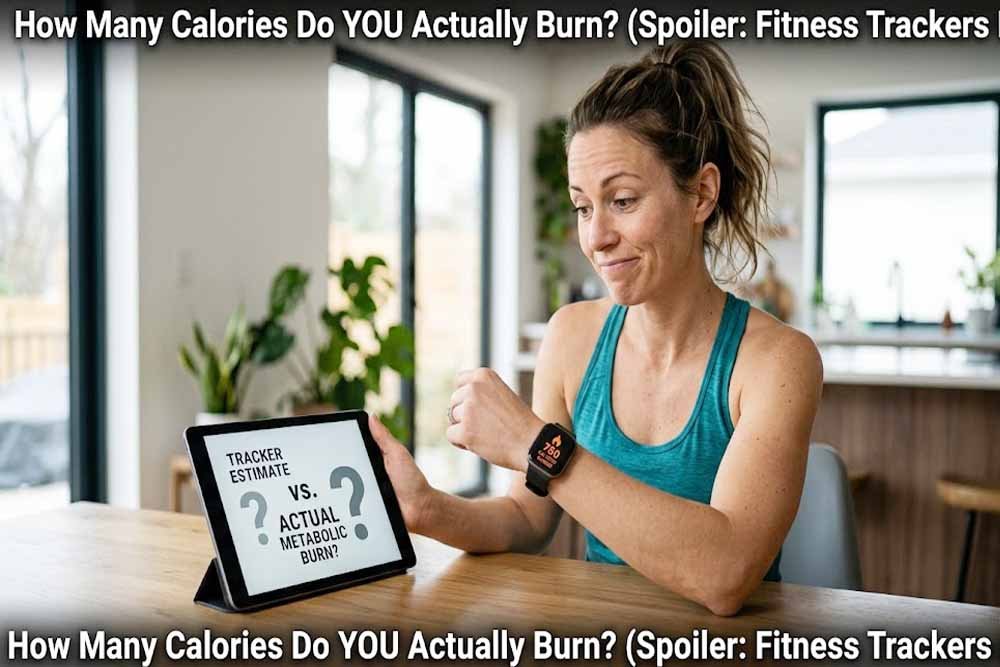
Fitness trackers are convenient. They’re also often 20–40% off on calorie estimates, and some studies have shown errors as high as 93% for certain activities.
Here’s why:
They use generic formulas: most devices plug your age, weight, and heart rate into an algorithm. That algorithm doesn’t know your body composition, fitness level, or metabolic efficiency.
Heart rate isn’t always reliable: Heart rate-based calorie estimates work reasonably well for steady-state cardio like jogging. For weight training, HIIT, or cycling? The numbers drift significantly.
They don’t account for fitness adaptation: The fitter you get, the more efficiently your body moves. A trained runner burns fewer calories at the same pace than a beginner, but your tracker doesn’t know that.
Wrist placement matters: Optical heart rate sensors on the wrist perform worse during strength training and exercises with heavy arm movement.
The bottom line: use trackers for trends, not absolutes. They’re decent at tracking relative effort over time. They’re bad at telling you to eat 400 more calories today because “you earned it.”
How Many Calories Do YOU Actually Burn During Exercise?
Here’s a rough snapshot for a 70kg person doing 30 minutes of different activities:
| Activity | Estimated Calories Burned |
| Walking (moderate pace) | 130–160 kcal |
| Running (10 km/h) | 300–350 kcal |
| Cycling (moderate) | 220–260 kcal |
| Swimming | 250–300 kcal |
| Weight Training | 140–200 kcal |
| HIIT | 240–400 kcal |
| Yoga | 100–140 kcal |
Notice how weight training looks low? That’s because the real calorie burn from lifting happens after the workout—through EPOC (Excess Post-Exercise Oxygen Consumption), also called the “afterburn effect.” Your metabolism stays elevated for hours. Trackers mostly miss this entirely.
If you want a more accurate personal estimate, tools like the Calorie Burn Calculator give you numbers based on your actual stats—not a generic profile.
Your Body Weight and Composition Change Everything
Two people doing the exact same workout burn different amounts of calories. Every time.
Body weight is the biggest factor—heavier people burn more calories doing the same activity because moving more mass requires more energy.
Muscle mass raises your resting metabolic rate. Every kilogram of muscle burns roughly 13 kcal/day at rest. That’s not huge per kilogram — but when someone has 10–15 kg more muscle than average, it adds up.
Age gradually lowers BMR, partly due to muscle loss. But this is more controllable than people think. Resistance training in your 40s, 50s, and beyond preserves metabolic rate significantly.
Sex plays a role too—men typically have a higher BMR due to greater muscle mass and testosterone. But the gap narrows considerably when body composition is similar.
If you’re serious about knowing your numbers, a proper TDEE calculation using your actual stats beats any tracker or rule of thumb.
NEAT: The Hidden Calorie Burner Nobody Talks About
Here’s the thing nobody tells you: two people with identical workout routines can have a 500–800 calorie difference in daily burn just based on how much they move outside the gym.
That’s NEAT. And it’s enormous.
A person who walks to work, takes stairs, fidgets, and does housework can burn 500+ more calories daily than someone who drives everywhere, sits at a desk, and takes the elevator. Same gym schedule. Completely different total burn.
This is why step count actually matters — not for the calorie estimate it gives you, but because it represents NEAT. Aiming for 8,000–10,000 steps daily is genuinely one of the most effective things you can do for total calorie expenditure, and it doesn’t require a single extra gym session.
How Many Calories Do YOU Actually Burn: What Affects Accuracy
If you want a more honest estimate of your personal calorie burn, here’s what actually matters:
- Use your real weight and height in any calculator — not what you think you weigh.
- Be honest about activity level. Most people overestimate how active they are.
- Choose the right activity MET value. “Going to the gym” isn’t one thing — an intense barbell session and a casual walk on the treadmill are completely different metabolically.
- Account for your fitness level. If you’ve been training for years, your calorie burn per session is likely lower than a beginner’s at the same perceived effort.
- Track trends over weeks. Weigh yourself weekly. If weight isn’t moving in the direction you want over 3–4 weeks at a given calorie target, adjust—regardless of what any tracker says.
People also ask
How many calories does the average person burn per day?
Most adults burn between 1,600 and 3,000 calories daily, depending on body size, age, sex, and activity level. A sedentary woman might sit around 1,700–1,900 kcal. An active man might reach 2,800–3,200 kcal. There’s no universal number—the range is wide.
Do fitness trackers overestimate or underestimate calories?
Both—but they more commonly overestimate calorie burn during exercise, particularly for strength training and HIIT. Studies consistently show errors of 20–93% depending on device and activity type.
Does muscle burn more calories than fat?
Yes, but not as dramatically as fitness culture suggests. Muscle burns roughly 13 kcal/kg/day at rest versus fat’s 4.5 kcal/kg/day. The bigger benefit of muscle mass is what it does to your metabolism over months and years of training.
How many calories do YOU actually burn walking 10,000 steps?
For a 70 kg person, roughly 300–400 kcal—but it varies with your pace, terrain, and body weight. Flat-surface walking at a casual pace sits lower; brisk walking uphill burns noticeably more.
Is it possible to calculate my exact calorie burn?
Not with complete precision outside a metabolic lab. But a good calculator using your weight, height, age, and activity type will get you within 10–15%, which is accurate enough to work with for most goals.
Can the food I eat affect how many calories I burn?
Yes. Protein has the highest thermic effect — around 20–30% of its calories are used in digestion. Processed foods have almost no thermic cost. So two diets with identical calories can have slightly different net effects based purely on food type.
Final Thought
How many calories What you actually burn isn’t a number you find on a screen—it’s something you estimate, observe, and adjust over time. Fitness trackers are a starting point, not a verdict. Your body is more complex than any algorithm.
The smartest approach: use a reliable calculator, be consistent with tracking, and let real-world results (weight trends, energy levels, performance) tell you whether your numbers are in the right range. No device replaces that feedback loop. Want to run your own numbers? The calorie calculators let you calculate BMR, TDEE, and activity-specific burn based on your actual stats.

Dr. Grace is a health and wellness content author dedicated to providing clear, accurate, and easy-to-understand information on nutrition, weight management, fitness, and general health. She focuses on original, evidence-informed content that helps readers better understand health topics and make informed choices.