
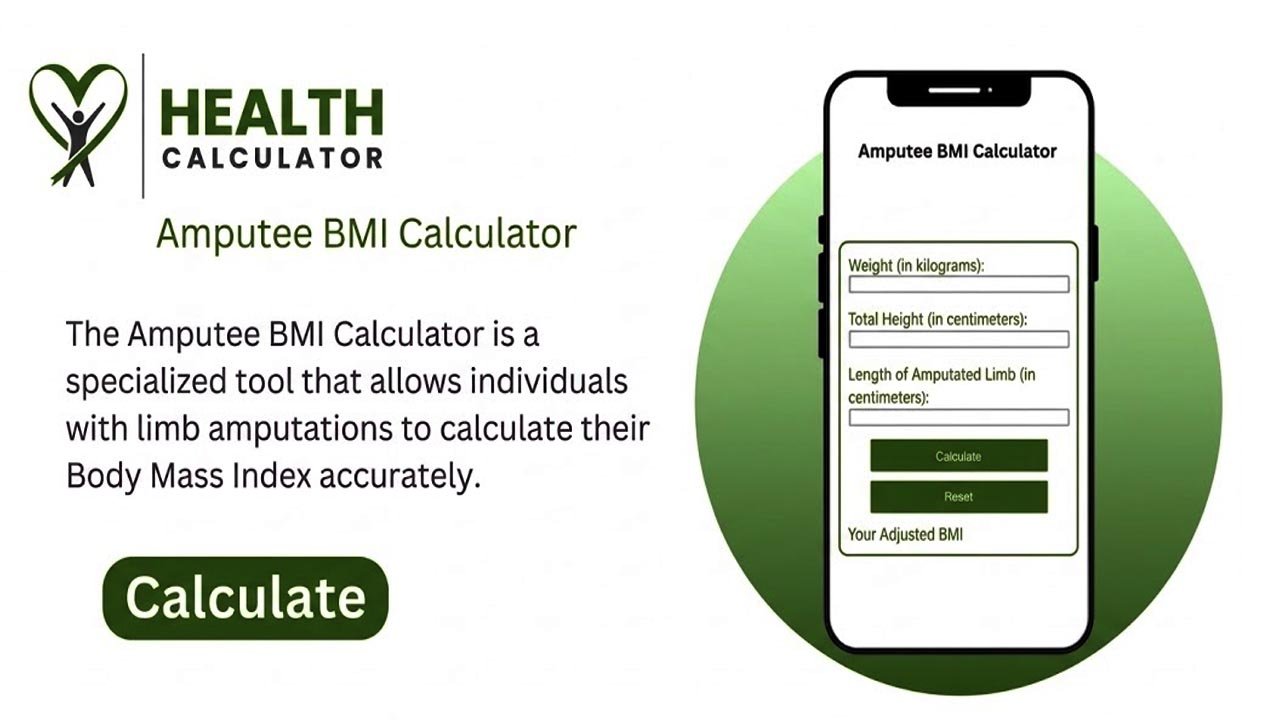
Most BMI tools give amputees wrong results. It is a known problem, and it has real consequences. When a standard calculator ignores your missing limb, it shows a lower BMI than your actual body composition. Doctors then get incomplete data. Your health decisions suffer.
Do you want a number that actually reflects your health? The right tool makes all the difference. A BMI amputee calculator adjusts the formula based on which limb is missing and how much body weight loss that limb represents. The result is far more accurate.
Keep reading. Below is everything about how adjusted BMI works, how to use it, and why it matters more than most amputees realise.
What is a BMI amputee calculator?
A standard BMI calculator uses your height and weight to produce a score. The formula divides your weight in kilograms by your height in metres squared. It works well for people without limb differences.
For amputees, the formula breaks down. Say a person lost a lower leg. That missing limb had weight. The standard formula does not add it back. So the final BMI score comes out lower than reality. The health picture gets distorted.
An amputee BMI calculator fixes this. It adds back the estimated weight of the missing limb before running the calculation. Researchers have studied how much each body part contributes to total body weight. A below-knee amputation accounts for roughly 5.9% of total body weight. Above-knee is around 11.0%. A full arm accounts for about 6.5%.
The calculator uses those percentages to adjust your weight upward before computing BMI. The result is called the ‘adjusted BMI’. It is significantly more reliable.
BMI Amputee Calculator
Get your adjusted BMI based on your amputation type. Standard BMI tools give incorrect results for amputees — this one does it right.
This tool is for informational purposes only. Please consult your healthcare provider for medical advice.
Why Standard BMI Fails Amputees
Standard BMI was never designed for people with amputations. It does not consider limb weight, muscle mass distribution, or residual limb length.
Research published in Prosthetics and Orthotics International shows that amputees who use standard BMI calculations are often classified as "healthy weight" when they may actually fall into the overweight range. That misclassification can lead to delayed medical care, poor prosthetic fit, and overlooked cardiovascular risk.
A study from the Journal of Rehabilitation Research and Development found that above-knee amputees showed BMI underestimation of up to 2 to 3 points when using standard formulas. That gap matters in clinical settings.
So if a doctor uses your standard BMI score to assess your health, he is working with incomplete data. An adjusted BMI gives a clearer and more honest picture.
How to Use the BMI Amputee Calculator on Health Calculator
The process is straightforward. Open the calculator on Health Calculator. It will ask for a few details:
- Your current weight in kg or lbs
- Your height in cm or feet and inches
- Type of amputation, such as below-knee, above-knee, below-elbow, or above-elbow
- Whether the amputation is on one side or both sides
The calculator then applies the right limb weight percentage to your total body weight. It adds back the estimated weight of the missing limb. After that, it runs the standard BMI formula on the adjusted weight.
The result appears in seconds. No login needed. No medical knowledge required.
Limb Weight Percentages Used in the Calculation
Different amputation types need different adjustment percentages. Researchers have worked to standardise these figures over the years. The commonly used values are as follows:
Hand — 0.8% of total body weight
Forearm (below elbow) — 2.3% of total body weight
Full arm (above elbow) — 6.5% of total body weight
Foot — 1.8% of total body weight
Lower leg (below knee) — 5.9% of total body weight
Full leg (above knee) — 11.0% of total body weight
Entire lower limb — 16.0% of total body weight
It is important to note that residual limb length also plays a role. A longer residual limb retains more mass. Some advanced calculators account for this. The Health Calculator tool uses standard published percentages, which provide a strong general estimate for most users.
What Your Adjusted BMI Score Means
Once the calculator gives you a result, here is how to read it:
Below 18.5 — Underweight. Consider speaking with a dietitian about your nutrition plan.
18.5 to 24.9 — Normal weight range. Your weight is in a healthy zone relative to your height.
25.0 to 29.9 — Overweight range. Some lifestyle adjustments may help here.
30.0 and above — Obese range. It is worth seeking medical guidance at this stage.
Keep in mind that BMI is a screening tool, not a diagnosis. It does not measure body fat percentage directly. It does not account for muscle mass or bone density. Think of it as a starting point for a broader health conversation with your doctor.
Height Measurement Tips for Amputees
Measuring height can be tricky if you have a bilateral lower-limb amputation or a congenital limb difference. A few practical options are available to you.
Wingspan measurement is one reliable method. Stand with your arms stretched out at shoulder height. Measure from the tip of your left middle finger to the tip of your right middle finger. For most adults, wingspan is very close to full standing height.
Pre-amputation height is another option. If you remember your height before surgery, use that figure. It is often the most accurate reference available.
Rehabilitation consultant records are also worth checking. Your rehab consultant may have documented your height during your care process.
Who Should Use the Amputee BMI Calculator
Any person with a limb amputation or limb difference can benefit from this tool. It is especially useful for:
Gym beginners with limb loss who want to track their fitness progress more accurately.
Prosthetic users need consistent weight data to ensure a good prosthetic fit over time.
People managing weight-related health conditions like diabetes, hypertension, or joint pain.
Anyone preparing for a medical appointment who wants to bring more accurate health data to their doctor.
A Real-World Example
Consider a man named Ahmed. He weighs 78 kg and stands 175 cm tall. He had a below-knee amputation on one leg. His standard BMI comes out at 25.5, which places him in the overweight range.
Now apply the adjustment. A below-knee limb represents 5.9% of total body weight. So the estimated weight of his missing limb is about 4.6 kg. Add that to his current weight. The adjusted weight becomes 82.6 kg. His adjusted BMI is now 27.0.
The difference is 1.5 BMI points. That shift matters. It gives Ahmed and his doctor a more honest number to work with. It also helps him set realistic weight goals.
People also ask:
Is adjusted BMI accepted by doctors?
Most doctors and physiotherapists are familiar with adjusted BMI for amputees. The concept is well-supported in rehabilitation medicine. It is always a good idea to mention that your BMI was calculated using an adjusted formula when discussing results with your healthcare provider.
Can the calculator work for bilateral amputees?
Yes. The calculator adds up the percentages for both missing limbs. So if a person has both legs amputated below the knee, the total adjustment would be around 11.8%.
Does the calculator store my data?
No. The Health Calculator tool does not collect or save any personal information. All calculations happen in your browser and stay private.
Is BMI enough to track health as an amputee?
BMI is a useful starting point. It is best combined with other indicators like waist circumference, activity level, diet quality, and regular blood work. No single number tells the full story.
What if I have a partial hand or partial foot amputation?
The calculator may not cover very partial amputations precisely. In those cases, speak with your rehabilitation consultant for a more tailored body composition assessment.
Final Thoughts
Standard BMI calculators were not built with amputees in mind. The gap in accuracy is real, and it can affect the quality of care a person receives. An adjusted BMI calculator does not require any special knowledge. It just needs the right inputs and the right formula.
Head over to the Health Calculator BMI Amputee tool. Put in your details. Get your adjusted BMI in seconds. Then take that number to your next doctor's visit and start a more informed conversation about your health.
Small tools can make a big difference. Start with the right one.

Dr. Grace is a health and wellness content author dedicated to providing clear, accurate, and easy-to-understand information on nutrition, weight management, fitness, and general health. She focuses on original, evidence-informed content that helps readers better understand health topics and make informed choices.