
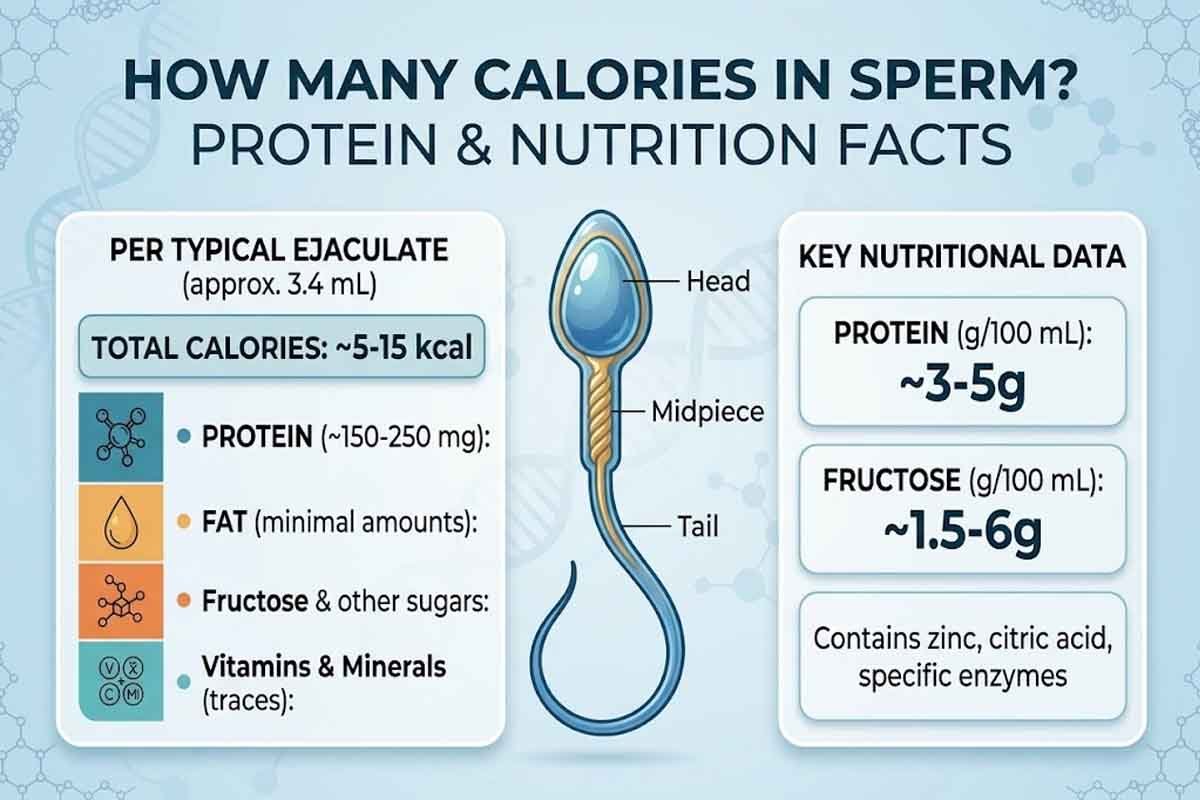
Wondering how many calories in sperm? The answer is that semen contains very few calories, but researchers have not established an exact calorie count for a typical ejaculation. Semen consists mostly of fluid, along with small amounts of protein, natural sugars, minerals, and sperm cells. At Health Calculator CO , we explain these nutrition facts in simple English, helping you separate scientific evidence from common internet myths.
Many people are curious about the nutritional content of semen, including its protein, vitamins, and possible health benefits. Although semen contains several nutrients, the quantity released during ejaculation is usually too small to provide meaningful dietary value. This guide explains its composition, protein estimates, calories, and important health considerations.
Quick Answer: Semen contains a very small amount of calories and is not a significant source of nutrition. You may see estimates of 5 to 25 calories online, but strong scientific evidence does not establish this as a reliable figure. One scientific review reported approximately 5.04 grams of protein per 100ml of semen, although actual concentrations vary.
How Many Calories Are in Sperm or Semen?
First, it is important to understand the difference between sperm and semen. Sperm are microscopic reproductive cells that can fertilize an egg. Semen is the fluid released during ejaculation that contains sperm cells along with secretions from reproductive glands.
Most online calorie questions actually refer to semen rather than individual sperm cells. Semen contains small amounts of carbohydrates, proteins, and fats, all of which can provide energy. However, there is limited research measuring the exact calories in a typical ejaculation.
Some websites quote five to twenty-five calories per ejaculation. These numbers should not be treated as verified nutritional facts because they are not supported by consistent laboratory calorie measurements.
What Is Semen Made Of?
Semen is primarily a mixture of water-based fluids produced by different parts of the male reproductive system. These fluids contain substances that help sperm survive and move.
Semen includes natural sugars, proteins, enzymes, and minerals. The composition can vary between individuals and even between different ejaculations from the same person.
| Component | Role in Semen |
|---|---|
| Water | Forms most of the fluid |
| Protein | Supports the fluid’s biological functions |
| Fructose | Provides energy for sperm cells |
| Zinc | Contributes to reproductive fluid functions |
| Calcium and Magnesium | Minerals involved in cellular processes |
| Sperm Cells | Carry genetic material for reproduction |
This table describes biological components, not recommended dietary nutrient sources.
Sperm Contains How Much Protein?
Semen contains protein, but the amount in a typical ejaculation is small. A scientific review of semen composition reported an average protein concentration of approximately 5.04 grams per 100ml.
If a sample contains 5ml of semen, this concentration would provide approximately 0.25 grams of protein. A 3ml sample would contain about 0.15 grams. These are mathematical estimates based on the reported concentration, not guaranteed values for every individual.
Protein in Sperm Per 100ml
One review of laboratory studies estimated semen protein at 5,040 milligrams per 100ml, equal to 5.04 grams. Researchers also noted that protein measurements vary considerably depending on the methods used.
This does not mean that a typical ejaculation provides five grams of protein. Ejaculation produces only a few millilitres of fluid, so the total amount of protein is much smaller.
| Semen Volume | Estimated Protein |
|---|---|
| 1 ml | 0.05 g |
| 3 ml | 0.15 g |
| 5 ml | 0.25 g |
| 10 ml | 0.50 g |
| 100 ml | 5.04 g |
Calculations use a published average protein concentration of 5.04g/100ml. They are illustrative laboratory-based estimates, not standardized food nutrition values.
Protein in Sperm Per 100g
People searching for protein in sperm per 100g often expect a food-style nutrition label. However, semen is normally measured by volume rather than weight in scientific studies.
If its density is assumed to be close to water, 100 grams would be roughly comparable to 100ml. Under that simplifying assumption, protein could be estimated at around five grams per 100 grams. This is not a verified standard measurement because actual density and protein concentrations vary.
More importantly, 100 grams is far greater than the amount normally released during a single ejaculation. The protein content of an ordinary sample therefore remains nutritionally insignificant.
Does Sperm Have Nutritional Value?
Semen contains several substances that are also found in foods, including protein, fructose, calcium, magnesium, and zinc. However, having nutrients does not automatically make something a useful nutritional source.
The amount of semen released during ejaculation is small. As a result, it cannot provide meaningful amounts of the protein, vitamins, minerals, or calories your body needs each day.
Foods such as eggs, beans, milk, nuts, vegetables, and fruit are much more practical sources of essential nutrients. A balanced eating pattern provides nutritional benefits that semen does not.
Does Sperm Have Vitamins?
Semen contains small amounts of certain vitamins and antioxidant compounds. Research has identified vitamin C in seminal fluid, while other sources describe trace amounts of vitamin B12.
However, the concentration of these nutrients is not consistent enough to consider semen a dietary vitamin source. Claims that semen contains as much vitamin C as an orange are not supported by reliable evidence.
Fruits, vegetables, dairy products, and other nutritious foods remain better ways to meet daily vitamin needs.
Sperm Macros: Protein, Carbs, and Fat
Macronutrients are the main nutrients that supply energy: protein, carbohydrates, and fat. Semen contains small amounts of all three, but it does not have a standardized nutrition label like ordinary foods.
| Macronutrient | Content | Dietary Significance |
|---|---|---|
| Protein | About 0.25g in a 5ml sample, estimated | Very low |
| Carbohydrates | Small amounts of natural sugars | Very low |
| Fat | Small amounts of lipids | Very low |
| Calories | Low; no reliable standard figure | Negligible |
The protein estimate assumes a 5ml sample and an average concentration from published research. Exact carbohydrate, fat, and calorie values are not reliably standardized.
Is Sperm Good for Skin?
You may have seen claims that applying semen to the face can improve skin texture, reduce acne, or prevent wrinkles. However, there is no convincing clinical evidence that semen provides these benefits.
Semen contains substances such as zinc and certain antioxidant compounds, but this does not prove that applying the fluid to skin is useful. Some people may also experience skin irritation or allergic reactions.
Contact with mucous membranes or broken skin can create additional infection concerns. For acne or sensitive skin, dermatologist-recommended skincare products are more appropriate.
Is Eating or Swallowing Sperm Good for Health?
There is no reliable scientific evidence that swallowing semen improves immunity, muscle growth, skin health, or overall nutrition. Although semen contains protein and minerals, the amount is too small to provide meaningful dietary benefits.
Swallowing semen itself is not generally considered toxic, but exposure during oral sex can carry health risks. Sexually transmitted infections such as gonorrhea, chlamydia, syphilis, and herpes can be transmitted through oral sexual contact.
HIV transmission through oral sex is much less likely than through vaginal or anal sex, but other STIs remain important concerns. Rare allergic reactions to seminal fluid are also possible.
Can Swallowing Semen Cause Weight Gain?
Swallowing semen is not expected to cause meaningful weight gain because the total energy content is very low. Body weight changes mainly reflect longer-term energy intake, energy use, and other health factors.
Since semen is not a meaningful source of dietary calories, there is no practical reason to include it in everyday food-calorie tracking.
Important Health and Safety Considerations
Understanding sexual health is more important than focusing on the small nutritional content of semen. The CDC explains that several STIs can spread through oral sex, sometimes without noticeable symptoms.
- Use protection: Condoms and appropriate barrier methods can reduce the risk of many STIs.
- Consider STI testing: Regular testing helps identify infections, including those without symptoms.
- Watch for allergies: Unusual swelling, itching, or irritation after exposure may require medical evaluation.
- Avoid unsupported claims: Semen is not a proven skin treatment, protein supplement, or remedy for medical conditions.
Frequently Asked Questions About Sperm Calories
How many calories are in one ejaculation?
One ejaculation contains very few calories. Online estimates commonly mention 5–25 calories, but there is not enough reliable research to confirm a standard value. The nutritional contribution is negligible.
How much protein does sperm contain?
A published review reported approximately 5.04 grams of protein per 100ml of semen. A 5ml sample would therefore contain around 0.25 grams of protein, using that estimate.
Does semen contain vitamin C and zinc?
Yes. Semen contains vitamin C and minerals including zinc. However, the small volume released during ejaculation makes it an insignificant source of these nutrients for a person’s diet.
Is semen good for acne or skin health?
There is no good clinical evidence that applying semen improves acne, wrinkles, or skin health. It can cause irritation or allergic reactions, so it is not recommended as a skincare treatment.
Can swallowing semen provide health benefits?
No meaningful nutritional or medical benefits have been established. Oral sexual contact can also transmit certain sexually transmitted infections. Safer-sex practices and testing help reduce these risks.
Is sperm high in protein compared with eggs?
No. One large chicken egg provides around 6.3 grams of protein, while a 5ml semen sample contains approximately 0.25 grams using the published average concentration. Eggs are a far more practical dietary protein source.
Final Thoughts
So, how many calories in sperm? Semen contains a very small amount of energy, but an exact calorie count per ejaculation is not scientifically established. It also contains small amounts of protein, carbohydrates, vitamins, and minerals, none of which make it a meaningful nutritional source.
At Health Calculator CO, our goal is to provide clear and accurate nutrition information. Understanding the difference between sperm and semen, recognizing unsupported health claims, and following safer-sex practices are more useful than relying on viral nutrition myths.
Scientific and Health References:
- Healthline – Semen Calories and Nutrition Facts
- WebMD – Nutrients in Semen and Safety
- Journal of Andrology – Review of Human Semen Composition
- Teaching Sexual Health – Semen Calories and Weight Gain
- Medical News Today – Semen and Skin Health
- CDC – STI Risks and Oral Sex
This article is intended for general health and nutrition education. Semen composition varies between individuals, and published nutrient measurements should not be treated as standardized food nutrition values. Consult a healthcare professional for personal sexual health concerns, STI testing, or suspected allergic reactions.

Dr. Grace is a health and wellness content author dedicated to providing clear, accurate, and easy-to-understand information on nutrition, weight management, fitness, and general health. She focuses on original, evidence-informed content that helps readers better understand health topics and make informed choices.