
Have you ever stepped on a scale and wondered, ‘Is this a healthy weight for me?’ A lot of people ask the same question. The truth is, your weight alone does not tell the full story. Two tools help answer this better – the ideal weight calculator and the BMI calculator. Both are widely used, but many people do not know the difference between them.
At Health Calculator, the goal is to make health tracking simple and accurate for you. So let’s break this down in a way that actually makes sense.
What Is BMI and How Does the BMI Formula Work?
BMI stands for Body Mass Index. It is a number calculated from your height and weight. The BMI formula is straightforward:
BMI = Weight (kg) ÷ Height (m)²
For example, if your weight is 70 kg and your height is 1.75 m, then BMI = 70 ÷ (1.75 × 1.75) = 70 ÷ 3.06 = 22.9
That number puts you in the “normal” range according to the BMI chart used by the World Health Organization (WHO).
The Standard BMI Chart (WHO Guidelines)
| BMI Range | Category |
| Below 18.5 | Underweight |
| 18.5 – 24.9 | Normal / Healthy |
| 25.0 – 29.9 | Overweight |
| 30.0 and above | Obese |
The BMI calculator kg with age feature on our platform uses these same categories. However, it is important to know that age does affect how you interpret your BMI results — especially for children and older adults.
For children and teens, the CDC recommends a BMI between the 5th and 85th percentiles based on age group. Adult BMI ranges are different. So always check which standard applies to your age group.
Ideal Weight vs BMI Calculator
Compare both metrics instantly — enter your details below
Gender
What is an Ideal Weight Calculator in kg?
The ideal weight calculator in kg works differently from BMI. Instead of giving you a category, it gives you a specific target weight range based on your height and gender.
Several medical formulas are used to calculate ideal body weight (IBW). The most common ones are:
- Devine Formula (1974) — Male: 50 kg + 2.3 kg per inch over 5 feet | Female: 45.5 kg + 2.3 kg per inch over 5 feet
- Hamwi Formula (1964) — Male: 48 kg + 2.7 kg per inch over 5 feet | Female: 45.5 kg + 2.2 kg per inch over 5 feet
- Robinson Formula (1983) — Male: 52 kg + 1.9 kg per inch over 5 feet | Female: 49 kg + 1.7 kg per inch over 5 feet
These formulas were originally developed for calculating medical drug dosages. Over time, they became useful tools for general health tracking as well.
So if you are a male at 5’10”, the Divine formula gives you an ideal weight of around 73 kg. That is a clear, specific number, which is very different from the range-based approach of BMI.
Ideal Weight vs BMI Calculator in kg — What Is the Real Difference?
Here is the key point. Both tools use your height and weight. But they answer different questions.
- The BMI calculator tells you which weight category you fall into.
- The ideal weight calculator tells you what weight you should aim for.
Think of BMI as a health screening tool. Think of ideal weight as a goal-setting tool. Both are useful — but for different purposes.
Which One Is More Accurate?
Neither one is perfect. BMI does not account for muscle mass. A very fit athlete may show a high BMI and still be in perfect health. The ideal weight formulas do not consider body fat percentage either. A person with low muscle mass and high fat may fall in the “ideal weight” range but still face health risks.
According to the WHO, BMI is a useful population-level measure but not always accurate for individuals. For personal health decisions, it is better to use both tools together.
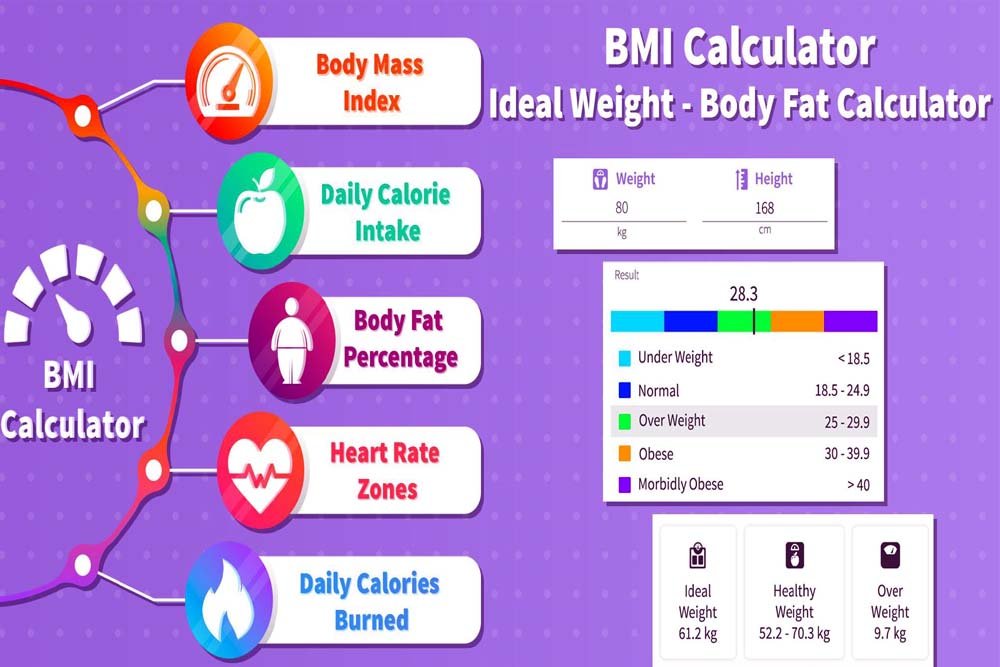
Ideal Weight vs BMI Calculator Male — What Men Should Know
For men, body composition plays a big role. Men naturally carry more muscle mass than women. So the ideal weight vs BMI calculator male results can sometimes show a higher BMI even when a man is fit and healthy.
For example, a 30-year-old male at 5’10” and 80 kg has a BMI of about 25.6—technically “overweight”. But if that person is a gym-goer with low body fat, that number is misleading.
The ideal weight range for the same man (using the Devine formula) would be approximately 70–77 kg. That gives a clearer goal to work toward.
It is also important to know that men tend to be taller and have higher bone density than women. So, ideal weight formulas for males use slightly higher base numbers.
Ideal Weight vs BMI Calculator Female — What Women Should Know
For women, the ideal weight vs BMI calculator female results work slightly differently. Women naturally carry a higher percentage of body fat even at a healthy weight. So a woman with a BMI of 22 may have a higher fat percentage than a man with the same BMI.
The ideal weight formulas for females start at a lower base weight. For a 5’5″ woman, the Devine formula gives an ideal weight of around 57–63 kg. A BMI for the same woman in the healthy range would be between 51 and 68 kg/m², a much wider window.
So, for women who want a specific target, the ideal weight calculator in kg gives a more focused number.
Body frame size also matters. A large-framed woman will naturally weigh more than a small-framed woman at the same height. Our calculator at Health Calculator accounts for this when giving results.
Ideal Weight vs BMI Calculator by Age — Does Age Change Everything?
Age matters more than most people think. As you get older, muscle mass naturally decreases, and body fat tends to increase. So a BMI of 24 at age 25 is very different from a BMI of 24 at age 65.
For the ideal weight vs BMI calculator by age, here is what you should keep in mind:
- Under 18 — Use the CDC BMI-for-age percentile chart, not the standard adult BMI range.
- 18–40 — Standard adult BMI and ideal weight formulas apply directly.
- 40–60 — Muscle loss begins. A slightly higher BMI (up to 27) may still be healthy.
- 60 and above — Studies suggest a BMI of 25–27 may actually be associated with better outcomes in older adults. [Source: National Institutes of Health]
So the answer is yes — age does change how you should read your results. A calculator that factors in age gives you a more honest picture.
How to Use Both Calculators Together
The smartest approach is to use both tools at the same time. Here is a simple plan:
Start with the BMI calculator kg with age to see your current health category.
Then use the ideal weight calculator in kg to find your target weight range.
Calculate the gap between your current weight and your ideal weight.
Use that gap to plan your calorie intake calculator, diet, or exercise routine.
At Health Calculator, all of these tools are available on one platform. You do not need to switch between multiple sites or apps. Just enter your details and get instant results.
Real Talk — What These Numbers Cannot Tell You
Here is something worth knowing. No calculator can fully define your health. IBW and BMI are useful starting points — not final judgements.
A person can be at their “ideal weight” and still have high cholesterol or blood pressure. Another person can be slightly above their BMI range and be in excellent shape. So treat these numbers as guides, not rules.
The most important factors for good health are still the basics — regular movement, a balanced diet, enough sleep, and managing stress. The calculators at Health Calculator are tools to support those habits, not replace them.
People Also Ask:
Is BMI or ideal weight more accurate?
Both have limitations. BMI is better for population-level health screening. An ideal weight is better for personal weight goals. Use both together for a fuller picture.
What is the ideal weight for a 5’5″ female in kg?
According to the Devine formula, the ideal weight for a 5’5″ female is approximately 55–63 kg, depending on body frame size.
Can I use the BMI calculator in kg with age for children?
Yes, but use the CDC BMI-for-age percentile chart for children under 18. Standard adult BMI ranges do not apply to children.
What is a healthy BMI for males?
The WHO defines a healthy BMI as 18.5–24.9 for both males and females. However, men with high muscle mass may show higher BMI without any health risk.
How do I calculate my ideal weight in kg?
Use the Devine formula — for males: 50 kg + 2.3 kg per inch over 5 feet. For females: 45.5 kg + 2.3 kg per inch over 5 feet. Or simply use the ideal weight calculator on Health Calculator for instant results.
Does age affect ideal body weight?
Age affects body composition, not the formula itself. But as you age, muscle loss and fat gain change how your results should be interpreted.
Final Thoughts
Both the ideal weight calculator and the BMI calculator are valuable tools. Each one tells you something different about your health. BMI gives you a category. An ideal weight gives you a goal. Used together, they give you a clearer path forward.
Do not let a single number define how you feel about your health. Instead, use these tools at Health Calculator to track progress over time. Small, consistent improvements always beat chasing a perfect number.

Dr. Grace is a health and wellness content author dedicated to providing clear, accurate, and easy-to-understand information on nutrition, weight management, fitness, and general health. She focuses on original, evidence-informed content that helps readers better understand health topics and make informed choices.